
Architecture3 min read
A station for the sky
What if a rooftop connection felt as familiar as stepping onto a railway platform?
Read articleAircraft & certification · 5 min read
Type certificates, operating rules and pilot programmes are converging—slowly. Where Joby, Archer, Vertical, EHang and the rest actually stand.
VERTISTATION.TOKYO Editorial
Sources reviewed
Share article
Type certification is the core permission for commercial passenger flight, and each manufacturer reports progress differently—Joby describes five stages and Archer four phases, so stage numbers alone do not establish who is closer. Joby began flying its first FAA-conforming aircraft for Type Inspection Authorization testing in March 2026, with FAA pilots expected to conduct “for credit” testing later in the year, and its August 2026 update reported progress in the fifth and final stage. Archer reported full FAA acceptance of Midnight’s means of compliance in March 2026, closing of the third of four phases by May 2026, and completed piloted city-to-city Midnight flights in August 2026—all preparation for operations, not a certificate.
Vertical Aerospace received a UK CAA Permit to Fly in November 2025 and began piloted transition testing, completed two-way transition flight in April 2026, then revised its certification target to 2029 in July 2026. Volocopter stated in January 2026 that it targeted EASA certification for VoloCity in 2027 and light-sport certification for VoloXPro by the end of 2026—targets, not approvals. Eve announced in July 2026 that Brazil’s ANAC opened consultation on Eve 100 airworthiness criteria and that it had applied to EASA to initiate type-certificate validation; an application is not completed validation.
EHang announced in March 2025 that two of its EH216-S operators had obtained air operator certificates from China’s civil aviation authority, enabling paid human-carrying flights at approved sites in Guangzhou and Hefei, on top of the aircraft’s existing type, production and airworthiness certificates. EHang’s own explanation distinguishes the approved “human-carrying” category from full “passenger transportation”, and describes sightseeing and other approved commercial uses. These are approvals under a different regulatory system; they do not transfer to FAA or EASA jurisdictions.
The FAA selected eight proposals for its eIPP integration pilot programme in March 2026, and subsequent reporting suggested the agency opened the possibility of commercial passenger and cargo operations under that programme before full type certification—an early-operations pathway, not proof that any aircraft is fully certificated. Schedules also differ within one company’s fleet: Beta Technologies’ runway-operated CX300 targets 2027 while its A250 eVTOL targets 2028, so fixed-wing progress should not be counted as eVTOL progress. For hotels and property owners, certification timing is the binding constraint on every service date discussed on this site.
A dated editorial review, not a live news feed. Announcements and targets are not evidence of operational services; follow the linked sources for subsequent updates.
Market reporting is separate from the fictional Tokyo 2045 vision. This site's images are AI-generated concepts, not photographs of the named projects. No affiliation with the organisations cited is implied.
What if a rooftop connection felt as familiar as stepping onto a railway platform?
Read article
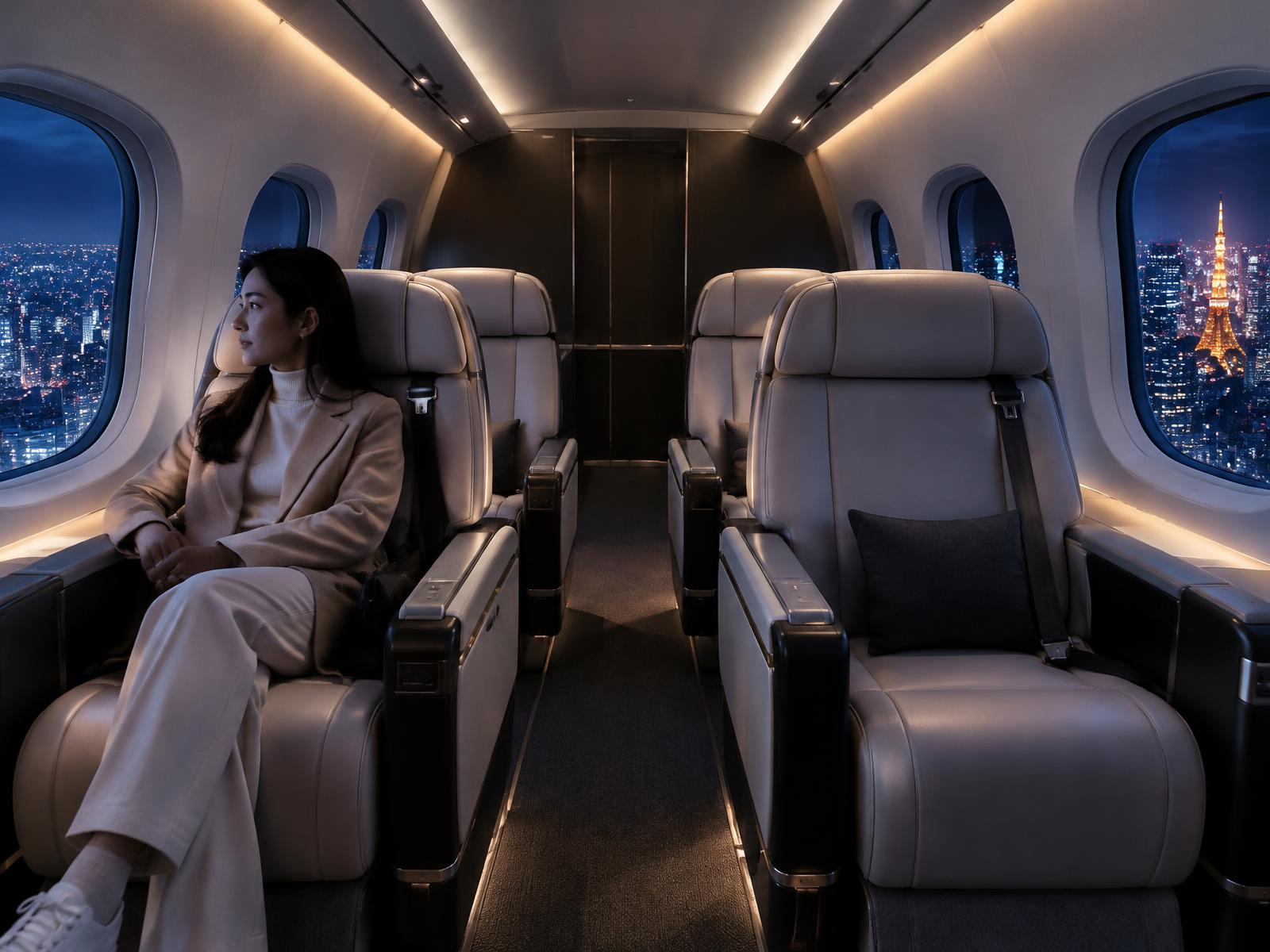
Imagining a passenger journey shaped by light, space and Japanese hospitality.
Read article
How a place-led digital identity can give an emerging idea a recognisable home.
Read article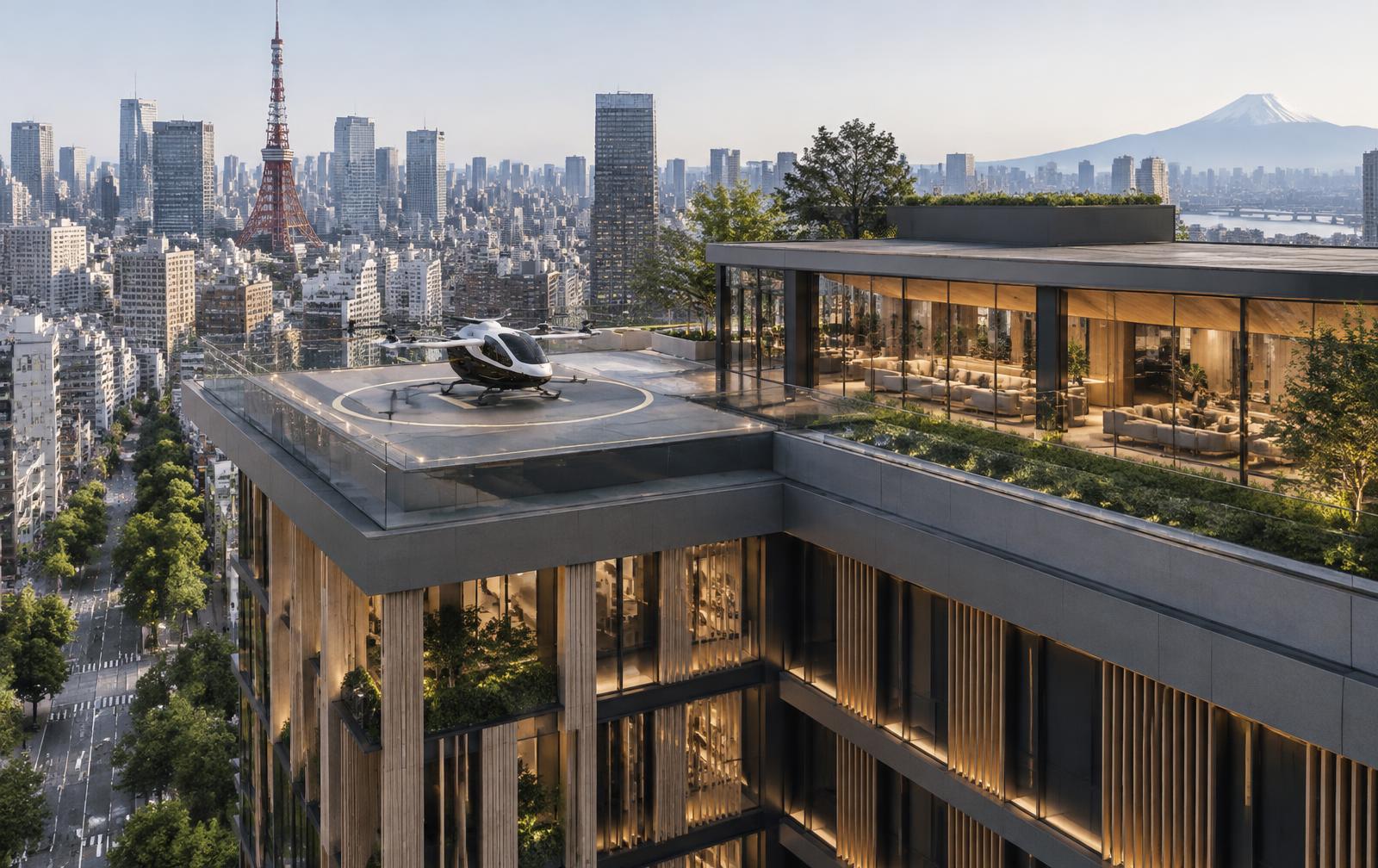
A proposed Wynn resort vertiport and an Ise-Shima feasibility study reveal how hospitality is exploring eVTOL connections—and what remains unproven.
Read articleRecent Japanese feasibility studies and infrastructure planning point toward regional networks, but announced targets are not commercial air taxi services.
Read article
Measured flyover data, community-response research and planning rules all point the same way: a quieter aircraft that still needs careful siting.
Read article
Developers are paying rent for rooftops and building vertiports at major destinations—but no independently verified valuation premium exists yet.
Read article
Central Tokyo to Narita in about 15 minutes, taxi-comparable pricing, Kansai postponed to FY2028. The announced plans—and the difference between a route and a ticket.
Read articleSkyports plans a vertiport integrated within the Wynn resort as Ras Al Khaimah moves toward a four-site air taxi network. What the September 2026 agreement does—and does not—confirm.
Read articleA mischievous 2045 daydream: the ten most romantic places to hover over Tokyo with someone you love—and the fine print that keeps it, for now, a fantasy.
Read article